
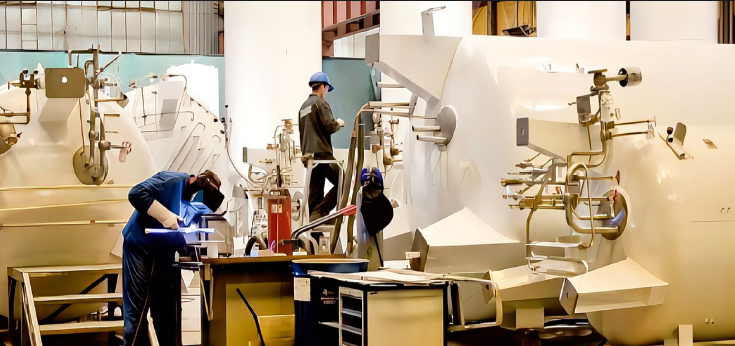
In industrial park centralized gas supply stations, the safe operation procedures for cryogenic equipment directly impact the stability and reliability of the gas supply system. Clarifying the dynamic judgment criteria for storage tank safety distances, the leak detection and emergency response mechanisms for pipeline networks, and the freeze and leakage prevention requirements for user-end meters are key to ensuring system safe operation.
Storage tank safety distances are not fixed lookup values but dynamically calculated based on actual volume and surrounding facility types. Multiple cryogenic storage tanks have varying volumes, with surrounding equipment such as ambient air vaporizer stations and pressure reduction and stabilization skids. Relevant regulations require that storage tank safety distances must comprehensively consider tank volume, medium characteristics, and adjacent facility types through calculations. For example, when the storage tank volume increases, potential risks rise accordingly, requiring proportionally larger distances to surrounding facilities. This dynamic judgment standard avoids resource waste or safety hazards caused by fixed standards, ensuring optimal layout while meeting safety requirements.
As the critical component for gas transmission, the pipeline network must be equipped with real-time monitoring systems and tiered response plans. The system should install online leak detection devices to monitor pipeline pressure, temperature, and flow changes in real time. Upon detecting abnormalities, the tiered response mechanism is immediately activated: minor leaks can trigger automatic isolation of affected sections and flow adjustments, while major leaks require emergency shutdown and activation of backup pipelines. This mechanism effectively controls accident scope and reduces impact on downstream users.
User-end meters are prone to freezing or leakage in low-temperature environments and must feature dual protection functions. This centralized gas supply station configures independent meters for each user, ensuring stable operation under long-term exposure to LO₂, LN₂, and other media. Meters should be manufactured from low-temperature-resistant materials and include built-in electric heating devices to prevent freezing. Additionally, dual leakage detection valves should be installed to verify seal integrity through positive and negative pressure tests. Emergency shut-off devices must also be equipped at user ends to quickly isolate meters in case of leakage and prevent medium dispersion.
The updated key points of cryogenic equipment safety operation procedures not only involve static parameters but also focus on dynamic risks and emergency measures. When selecting equipment, priority should be given to devices compliant with standards such as GB/T 18442 and TSG 21, with safety distances and protective measures adjusted based on actual conditions. Operators must regularly inspect key indicators like storage tank vacuum levels and pipeline leak rates to ensure system controllability. User-end meters should establish inspection routines to promptly identify and address freezing or leakage risks. Through these measures, the safety of cryogenic equipment applications can be effectively enhanced, safeguarding long-term stable operation of gas supply systems.
Cryogenic Pressure Piping and Components · Safety Operation Procedures and Precautions for Cryogenic Storage Tanks