
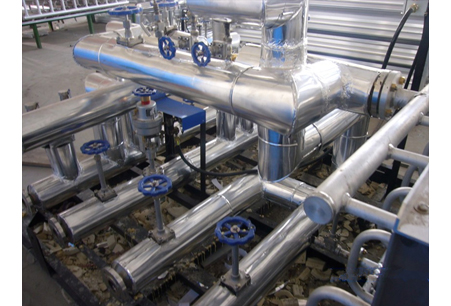
When establishing cryogenic pipeline insulation repair standards, it is essential to comprehensively consider pipeline materials, insulation methods, and operating conditions to ensure the repaired system meets design requirements and achieves long-term stable operation. In applications such as gas distribution stations, cryogenic pipelines transport media like liquid oxygen (LO₂) and liquid nitrogen (LN₂), which have extremely low boiling points. Pipeline materials are typically TP304 or TP316L stainless steel, with design temperatures reaching -196°C and design pressures ≤4.0MPa. Insulation methods commonly include vacuum-insulated pipes or polyurethane foam, with supporting components such as cryogenic shut-off valves and check valves. These factors directly influence the selection of repair processes.
Significant differences exist in repair materials and processes for pipelines of different materials. TP316L, containing a higher proportion of nickel and molybdenum, offers stronger corrosion resistance and high-temperature performance, making it suitable for scenarios with larger temperature fluctuations or stronger acidic media. Repair materials must be chemically compatible with the original pipeline material to prevent stress corrosion or accelerated corrosion due to material mismatch. For example, when repairing pipelines transporting LO₂, if the original material is TP316L, the same material should be prioritized for reinforcement or replacement. If downgraded to TP304, the vacuum retention capability and long-term operational stability after repair must be reassessed.
Repair processes must be compatible with the original insulation method and design temperature. For pipelines using vacuum-insulated pipes, repairs must strictly adhere to the GB/T18442 standard for vacuum insulation performance recovery to ensure the repaired vacuum level remains within design limits. If the original insulation method is polyurethane foam, repairs should use the same or polyurethane with a similar thermal expansion coefficient to avoid deformation or internal stress concentration due to material differences.
The characteristics of the transported medium and working pressure determine the sealing performance and durability after repair. In gas distribution stations, pipelines transport LN₂ with design pressures ≤4.0MPa. Improper repair processes may lead to sealing failure or leaks, potentially causing low-temperature frostbite or explosion risks. Therefore, cryogenic shut-off valves and check valves must undergo pressure testing after repair, with test pressures determined by design conditions and holding times of at least 30 minutes. Additionally, environmental temperature effects must be considered. If ambient temperatures are excessively high (≥+10°C), polyurethane foam material performance may degrade, requiring cooling measures or the use of high-temperature-resistant materials. Furthermore, the phase change characteristics of the transported medium must be addressed. At a design temperature of -196°C, if insulation performance declines after repair, the static evaporation rate will significantly increase, requiring improved repair processes to reduce heat leakage.
Cryogenic pipeline insulation repair requires a comprehensive evaluation of pipeline materials, insulation methods, and operating conditions. Accurate pipeline material identification before repair, high-compatibility material and process selection during repair, and post-repair validation based on operating conditions are essential. Reference relevant standards and combine with equipment nameplate parameters to determine repair solutions. For pipelines with TP316L material and a design temperature of -196°C, repairs should ideally use the same material and ensure the static evaporation rate meets design conditions. For ambient air vaporizers, repaired vacuum levels should align with nameplate parameters and undergo environmental temperature adaptation testing. Properly understanding and executing repair standards can effectively extend the service life of cryogenic pipeline systems and ensure safe, stable operation.