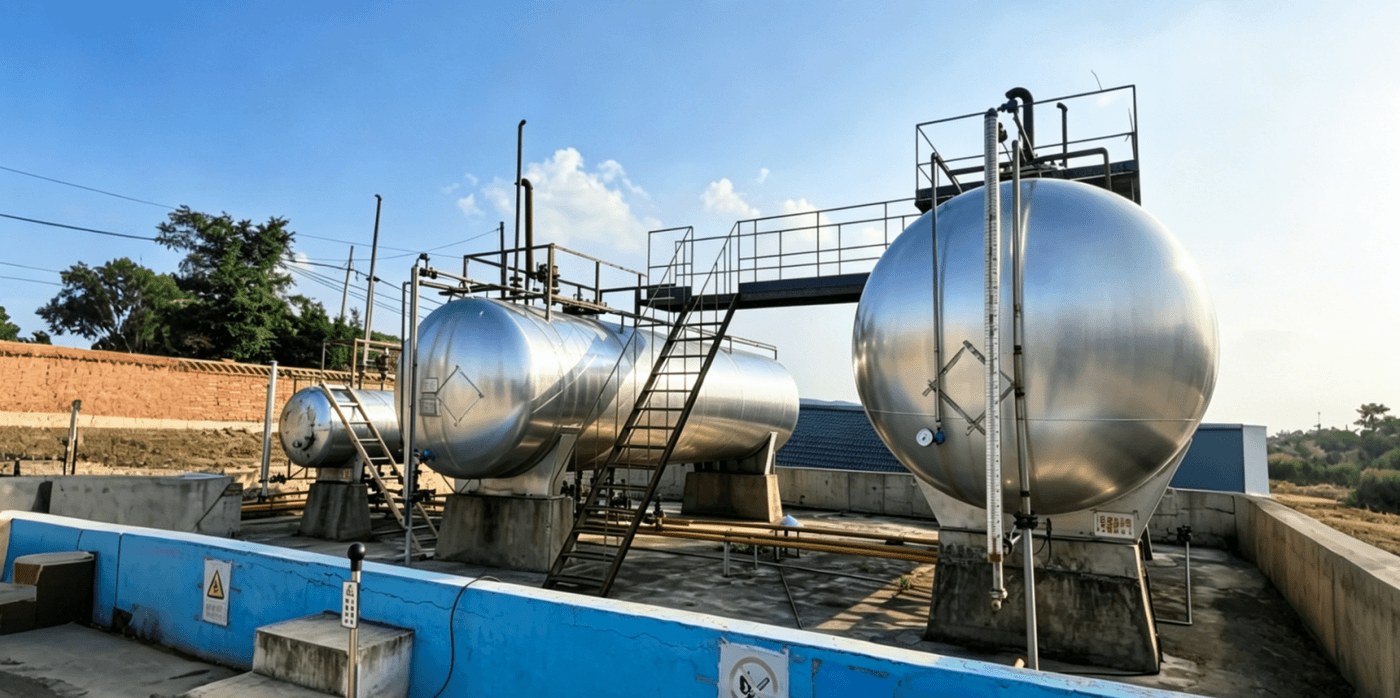
In industrial park centralized gas supply station projects, multiple parallel cryogenic storage tanks (one for oxygen, nitrogen, and argon each) supply gas to enterprises on demand through shared ambient air vaporizer stations and dual-path gas pressure regulating skids. The design of such non-standard cryogenic tanks must strictly adhere to GB standards to ensure operational safety and compliance. GB standards impose mandatory requirements on material selection, safety distances, and interface specifications, with the following key elements analyzed.
GB standards specify the minimum performance requirements for cryogenic tank materials, including low-temperature impact toughness, corrosion resistance, and mechanical stability under specific conditions. Materials must undergo rigorous low-temperature impact tests, with absorbed energy values meeting certain thresholds. This requirement stems from the brittle transition characteristics of materials in low-temperature environments. If non-compliant materials are used, tank cracks may propagate due to material embrittlement, potentially established to leaks.
GB standards regulate safety distances based on storage tank volume and surrounding facility types to quantify fire and explosion risks. In the aforementioned gas supply station project, GB/T14976 standards mandate that fire protection distances from high-traffic areas for single tanks exceeding 5 cubic meters must be determined based on design conditions, with horizontal distances from high-pressure gas pipelines further widened according to pipeline pressure. For the three parallel liquid nitrogen tanks with an undefined total volume, standards require sufficient distance from the main factory road and the establishment of explosion-proof isolation belts meeting minimum specifications. These distances account for potential leak dispersion ranges, vapor explosion power, and evacuation times—any reduction would significantly amplify accident consequences.
GB standards impose mandatory requirements on connection interfaces between vaporizers and storage tanks, primarily concerning pipeline materials, welding processes, and pressure level matching. In the centralized gas supply system, ambient air vaporizers connected to liquid argon storage tanks must use seamless stainless steel pipelines compliant with GB/T8163 standards, with welds subjected to ultrasonic testing. Standards also specify that the maximum working pressure at connections must not exceed tank test pressure, and pressure relief devices with bursting discs must be installed. Interface tolerances must remain within reasonable limits—exceeding them may lead to sealing failures. GB/T18442 standards require all connection points to undergo leak testing after installation, using pressure hold observation methods, which effectively prevents early-stage leaks due to interface issues.
The selection and configuration of non-standard cryogenic tanks must comprehensively consider application purposes, medium characteristics, usage demands, site conditions, and power/gas supply reliability. In the gas supply station system, equipment capacity is determined by the total tank volume, vaporizer processing capacity, pressure regulating skid flow rate, and pipeline transport pressure, forming a dynamic equilibrium—insufficient capacity in any component reduces overall system efficiency. Tank volumes must be calculated based on instantaneous demand, with pressure regulating skids configured for maximum flow rounded up. However, limited site conditions may allow reduced configurations paired with emergency plans, provided risk control is mathematically demonstrated. Non-standard cryogenic tank design must base itself on GB standards while scientifically assessing actual conditions to ensure safe and reliable operation. On-site inspections must verify whether equipment nameplate parameters align with design conditions.