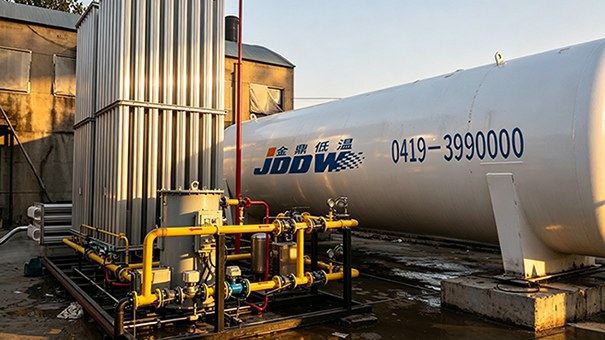
Liquefied Natural Gas Storage Tank often face long-term idleness due to pipeline maintenance or business adjustments. The safety of equipment for safe operation becomes a key issue. Taking urban bus, heavy-duty truck, and long-haul logistics vehicle refueling stations as examples, these LNG Storage Tank need to store Liquefied Natural Gas at -162°C, with single tank capacity ranging from 20 to 150m³, equipped with unloading Pressurization, refueling machines and other equipment to meet vehicle refueling needs. What impact does long-term non-use have on the structure of the Storage Tank? What requirements does the regulation impose on the inspection of the Storage Tank?
The most significant problem for long-unused LNG Storage Tank is the decline in vacuum performance of the interlayer. The interlayer is the core part of Vacuum Insulation. If leakage occurs, it will cause the Vacuum Level to deviate from the design range, reduce insulation efficiency, and increase LNG evaporation loss. Leakage may result from Valve seal failure, weld cracking, or material aging, requiring professional detection confirmation. For example, the GB/T 18442 series standards specify the detection methods for the vacuum performance of the Storage Tank. If the interlayer leakage rate rises significantly, it indicates that the Storage Tank can no longer meet the original insulation requirements.
The TSG 21-2016 standard clearly specifies the periodic inspection cycle and items for LNG Storage Tank. Metal Pressure Vessel requires initial periodic inspection within 3 years after commissioning, with subsequent inspection cycles determined based on safety condition grade: Grade 1 and 2 generally require inspection every 6 years, while Grade 3 generally requires inspection every 3 to 6 years. Inspection items include container pressure resistance, interlayer leak detection, vacuum performance testing, etc., to ensure the Storage Tank remains in a safe condition. If defects are found during inspection, they must be addressed in accordance with standard requirements, otherwise the equipment cannot continue to be used.
For long-unused LNG Storage Tank, a comprehensive inspection and evaluation should be conducted before resuming operation, including Vacuum Level testing, air tightness test, etc., to ensure compliance with safety operation standards. If the equipment has expired the inspection cycle or shows obvious signs of aging, replacement or repair should be considered. Selecting LNG Storage Tank that meets GB/T 26978 and other standards, and implementing inspection in accordance with GB/T 20368 and other specifications, is key to ensuring equipment safety. For more detailed information on LNG Storage Tank, refer to LNG Storage Tank.