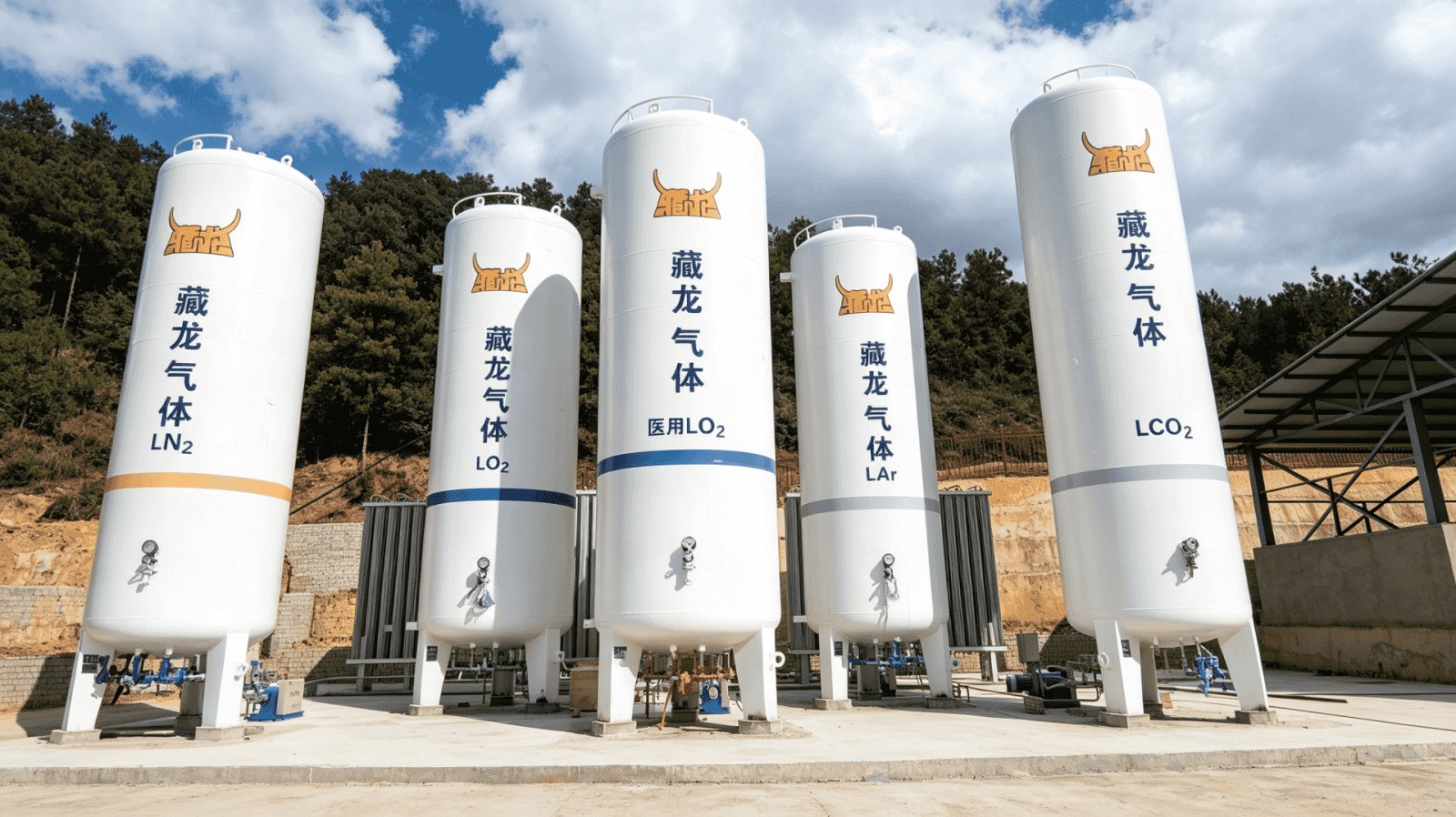
Maintenance of Cryogenic Liquid Storage Tank (such as Oxygen-Nitrogen-Argon Storage Tank) must be performed by personnel with professional knowledge and skills, as these equipment are classified as special equipment. In industrial park centralized gas supply stations and other scenarios, they are core equipment ensuring stable operation of gas sales, and together with Atmospheric Vaporizer, Pressure Stabilization Skid, etc., they constitute the gas supply system, providing convenient on-demand gas services for industries such as mechanical processing and chemical industry.
According to the "Safety Law of the People's Republic of China on Special Equipment" and relevant regulations, operators and maintenance personnel of Cryogenic Liquid Storage Tank must be certified. The high-risk nature of the equipment determines this requirement—Tank Shell may experience brittle cracking under low-temperature environment, and the stored medium (such as LO₂, LN₂) poses risks of asphyxiation and frostbite. Holding a certificate certifies individual skills and reflects responsibility for life and property safety. Operators must be familiar with equipment operation procedures, emergency response measures, and standardized use of safety accessories (such as Safety valve, Pressure Gauge), all of which must be obtained through professional training and assessment for qualification certification.
As Pressure Vessel, Cryogenic Liquid Storage Tank must comply with the "Fixed Vacuum Insulation Deep Cold Pressure Vessel" (GB/T 18442 series standards) and the "Safety Law of the People's Republic of China on Special Equipment" in terms of design, manufacturing, inspection, and use. For example, if a CO₂ Storage Tank with a volume of 15.8m³ is used for storing carbon dioxide, its vessel category is Class II or Class III Pressure Vessel, which must be designed and manufactured by units with A3 level qualification, and must undergo manufacturing supervision inspection and registration. Maintenance personnel must ensure key steps before first use, such as Tank Shell Pre-cooling and Vacuum Level inspection. During daily storage, keep away from heat sources, maintain ventilation, and strictly prohibit open flames nearby—these measures aim to prevent accidents caused by improper operation.
Maintenance operations of Cryogenic Liquid Storage Tank involve multiple risks, including low-temperature frostbite, high-pressure explosion, and gas leakage due to improper maintenance. The "11.13" accident in Hangzhou, where a CO₂ Storage Tank exploded due to brittle cracking of weld seams, exposed neglect of material performance and stress control during maintenance. Maintenance personnel must strictly follow safety regulations: prohibit wearing electrostatic-generating clothing and nail-studded shoes when entering the site; control the speed of motor vehicles; install Lightning Protection Static Electricity Protection facilities; lighting and electrical equipment must meet explosion-proof standards. The storage area should be cool and well-ventilated, with a temperature not exceeding 30°C, and must be strictly fireproof to ensure the safety of the working environment.
Maintenance personnel must master the classification and qualification standards of inspection items. Visual and tactile inspection can initially identify obvious issues such as leakage and deformation, while indicators such as Vacuum Level and Static Evaporation Rate must be measured using instruments. If abnormalities are found, they must be classified and handled according to severity: minor issues can be addressed within a specified period, while major defects (such as Vacuum Level significantly deviating from design range) require immediate shutdown of the equipment. After maintenance is completed, the inspection results should be recorded and a report signed to ensure traceability and verifiability of every operation.
Selecting qualified maintenance personnel is the foundation for ensuring the safe operation of Cryogenic Liquid Storage Tank. Enterprises should prioritize teams with relevant qualifications and practical experience, and regularly organize safety training and emergency drills. Daily inspection and maintenance of the equipment must be planned based on design conditions (such as 0.8 ~ 3.5MPa Working Pressure, Vaporizer outlet temperature ≥ ambient temperature -10°C), ensuring all operations comply with standard requirements. Through scientific management and standardized operations, the risk of accidents can be effectively reduced, and the service life of the equipment can be extended.
Cryogenic Pressure Piping and Components