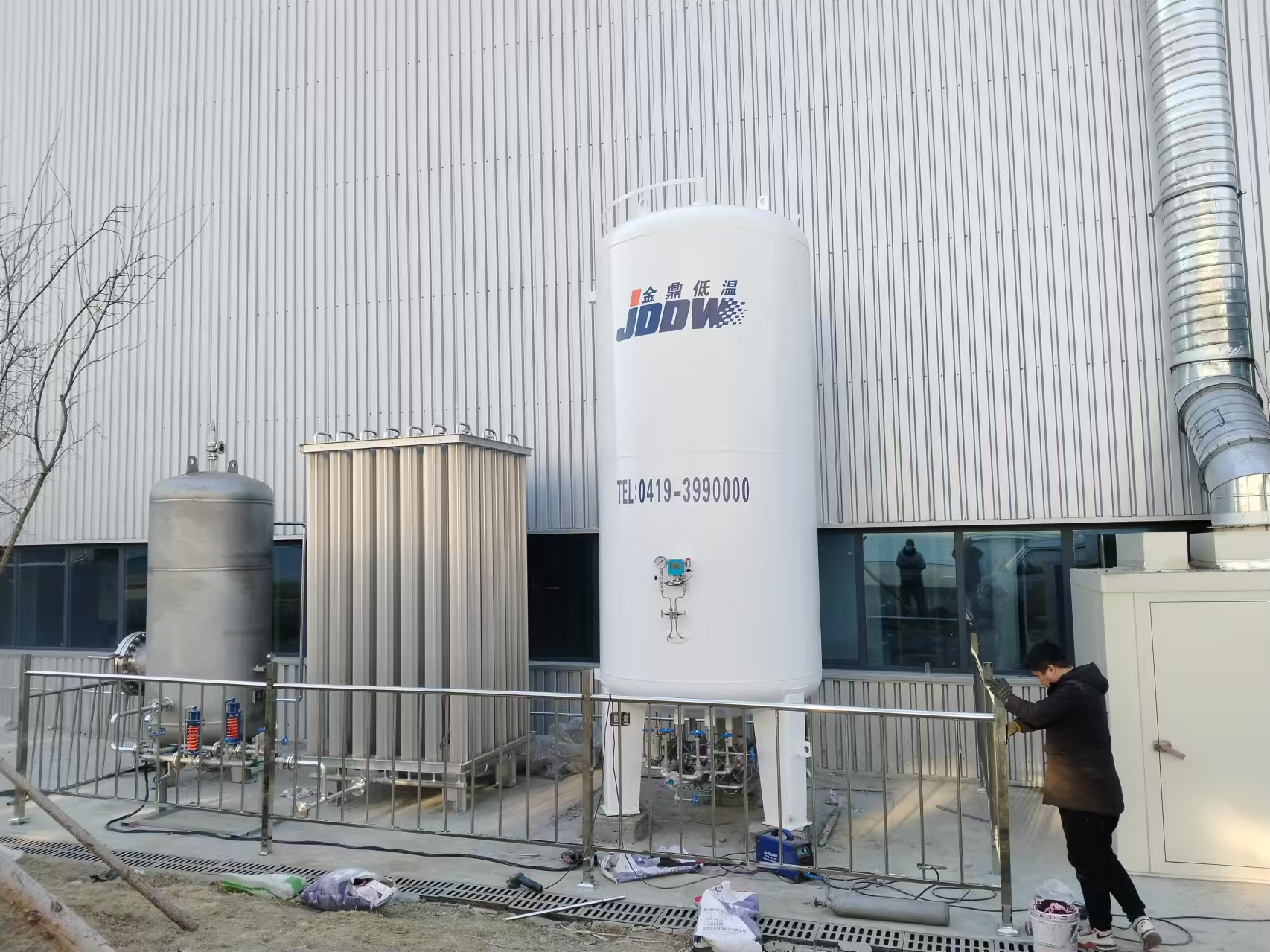
In Industrial Gas supply scenarios such as centralized gas stations in industrial parks, the Cryogenic Storage Tank is a core equipment, and its safe and stable operation is crucial. The regular calibration of safety accessories such as Safety valve and Pressure Gauge is a key step to ensure equipment safety. This article elaborates on the regular calibration procedures for safety accessories of Cryogenic Storage Tank based on GB/T 18442 series standards and industry practices.
Cryogenic Storage Tank is commonly used to store LO₂, LN₂, LAr and other cryogenic media, with a Working Pressure range of 0.8 ~ 3.5MPa. In gas sales applications, multiple Cryogenic Storage Tanks are often arranged in parallel with Atmospheric Vaporizer, dual-path Pressure Stabilization skids and other equipment to form a complete gas supply system. Regular calibration of safety accessories such as Safety valve and Pressure Gauge can promptly identify potential equipment risks and prevent accidents such as leaks and explosions caused by accessory failure. For example, if a Safety valve fails to operate at the start pressure, it must be recalibrated immediately; the periodic calibration of Pressure Gauge and Safety valve is a mandatory requirement.
Before starting the operation, it must be confirmed that safety accessories such as Safety valve and Pressure Gauge are in good condition and check whether the Vacuum Level meets the standard. If the Vacuum Level of the vacuum-sealed Vacuum Powder Insulation Storage Tank (1~10m³) exceeds 2Pa, or the cold vacuum level exceeds the design range, the operation is directly prohibited. Throughout the process, pressure test and leak tightness test are prone to issues. During the pressure test, if abnormal deformation occurs on the inner container wall plates or Welding joints leak, the test must be stopped immediately and the cause analyzed; in the leak tightness test, if the Nozzle reading of the vacuum gauge exceeds 10Pa after pressure holding, it indicates a leak, and repair is required before retesting.
After the operation, record the calibration data, including the calibration pressure of Safety valve, the accuracy of Pressure Gauge, and the test results of Vacuum Level, and recheck whether all accessories have returned to normal function. In addition, check whether the Safety valve has frequent jumping records. If such cases exist, the problem of interlayer leakage must be given priority in inspection.
During selection, appropriate safety accessories should be chosen based on the Storage Tank volume, medium type, and operating conditions. During use, pressure and leak tightness tests must be strictly carried out in accordance with GB/T 18442.5-2019 standard, and the Static Evaporation Rate should be regularly tested. If the equipment is used in special scenarios such as hospital Liquid Oxygen supply, it must also comply with WS 435-2013 regulations, with Safety valve calibrated at least once a year and Pressure Gauge calibrated every six months according to metrological regulations. The integrity of the Safety valve's lead seal should be checked, and the date of the last calibration should be verified.