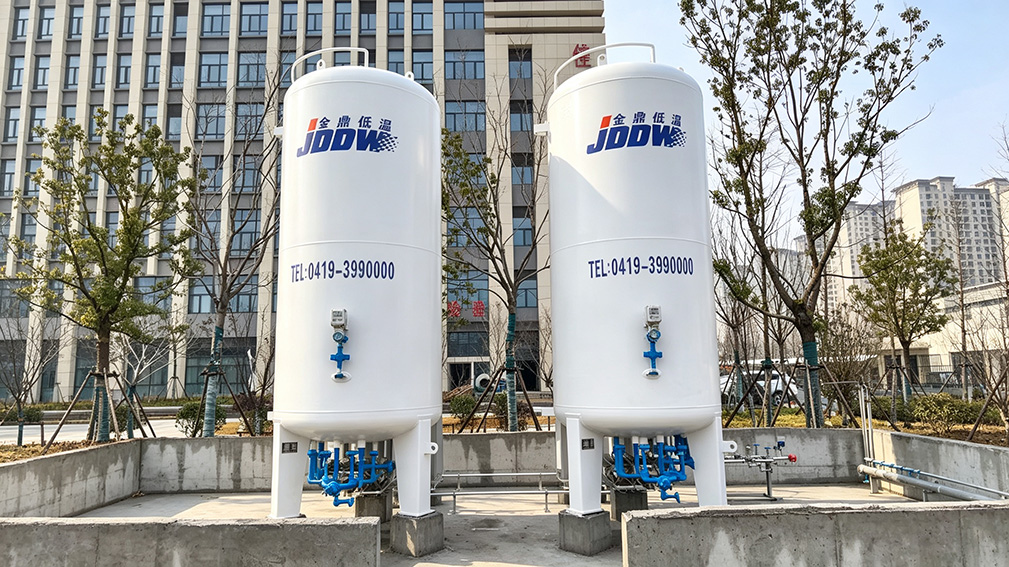
The safe operation of medical liquid oxygen storage tanks is critical for life-saving oxygen supply in hospitals and other institutions, requiring standardized design, equipment configuration, and safety management. For example, in medical center oxygen supply systems, 5-15m³ medical liquid oxygen storage tanks serve as the primary gas source, paired with Atmospheric Vaporizers, Pressure Regulator, and pressure stabilization tanks to provide 24-hour stable oxygen supply, ensuring uncompromising safety.
Medical liquid oxygen storage tanks must be equipped with fire dikes meeting volume and height requirements to prevent leakage spread, fire, or environmental pollution. According to GB 50751-2012, Article 4.6.3, fire dikes should be installed around medical liquid oxygen storage tank stations, with effective volume not less than the largest tank and height not less than 0.9m. This regulation ensures that even in case of leakage, liquid oxygen remains contained within the dike, preventing wider spread.
Medical liquid oxygen storage tanks must have independent lightning and static electricity grounding systems with regular inspections to eliminate risks of explosion from lightning strikes or static sparks. GB 16912-2008, Table 4 specifies that the impact resistance of lightning grounding for outdoor air separation units, oxygen production rooms, oxygen filling stations, and oxygen storage tanks shall not exceed 30Ω. GB 50030-2013, Article 8.0.8 further requires that grounding resistance for equipment accumulating liquid oxygen shall not exceed 10Ω. All lightning and static electricity grounding devices must be inspected at least once annually to ensure continuous effectiveness.
The fire distance between oxygen storage tanks must be determined based on their volume to prevent fire spread. While GB 50030-2013, Article 3.0.17 does not explicitly state numerical distances, it clarifies on page 21 that the fire distance between oxygen storage tanks shall not be less than the radius of the larger adjacent tank, and the fire distance between oxygen storage tanks and flammable gas storage tanks shall not be less than the diameter of the larger adjacent tank. This requirement ensures that even if one tank experiences an incident, it will not quickly affect neighboring equipment.
When selecting medical liquid oxygen storage tanks, prioritize equipment compliant with GB 50751-2012 and GB 16912-2008 standards, paired with Atmospheric Vaporizers (e.g., 50~2000 Nm³/h models) and secondary pressure regulating and stabilizing stations. The inner vessel should be made of S30408 stainless steel, with the outer shell of Q345R pressure vessel steel to ensure long-term stable operation. During initial filling or maintenance, strictly adhere to safety operating procedures, particularly those for pressure operations.
Liquid Oxygen Storage Tank · Medical Center Oxygen Supply · Liquid Oxygen Storage Tank Shipped to a Steel Plant in Northeast China