
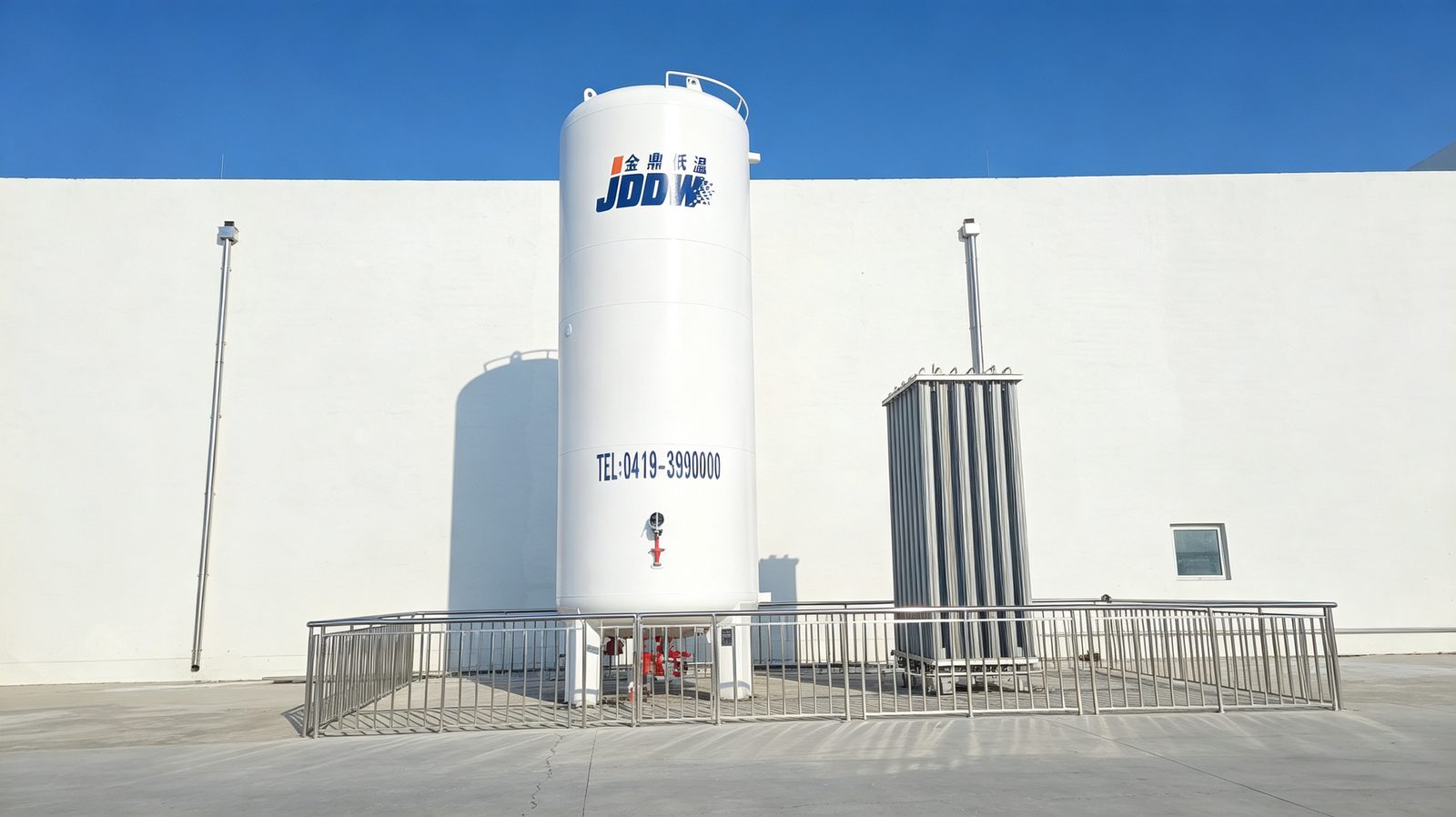
Verify the installation records and qualification documents of liquid nitrogen storage tanks to confirm compliance with national standards, which is essential for ensuring safe and efficient operation in a -196℃ cryogenic environment. As special equipment, the installation process must strictly follow national safety standards for special equipment to guarantee personnel safety and equipment performance.
Installation of liquid nitrogen storage tanks must comply with national safety standards for special equipment. Relevant regulations require that the design, manufacturing, inspection, use, and installation of such equipment undergo review and supervision by qualified professional institutions. During installation, all operations must adhere to the GB/T 18442 series standards, particularly the general requirements and basic provisions outlined in GB/T 18442.1-2019 "Fixed Vacuum Insulated Cryogenic Pressure Vessels, Part 1: General Requirements." Non-compliant installation may lead to serious safety accidents, making it crucial to select a qualified installation team.
When selecting liquid nitrogen storage tanks, the actual application scenario must be taken into account. For example, in hospital central laboratories or biological companies for biological sample storage, 5-10m³ self-pressurization liquid nitrogen storage tanks are typically used, paired with liquid nitrogen distribution pipelines, automatic replenishment systems, and low liquid level alarm devices to provide continuous and stable liquid nitrogen supply. In the food ultra-low temperature rapid freezing field, 10-20m³ liquid nitrogen storage tanks combined with tunnel rapid freezing machine liquid nitrogen spraying systems and pressure reduction distribution skids can achieve fast freezing for seafood, crayfish, and other products. Additionally, the choice of working pressure must align with usage requirements. Low-pressure models (0.8MPa) have a lower self-evaporation rate, suitable for static storage, while high-pressure models (1.6MPa or 2.5MPa) offer higher flow rates, ideal for continuous supply scenarios.
The insulation structure of liquid nitrogen storage tanks has a determining impact on performance. High-quality liquid nitrogen storage tanks employ double-layer vacuum insulation, with the inner vessel made of S30408 stainless steel and the outer shell of Q345R pressure vessel steel. The insulation layer is filled with efficient materials (e.g., perlite) and evacuated to a high vacuum, minimizing thermal leakage. This structure ensures the daily evaporation rate is controlled within 0.1%~2%, guaranteeing long-term stable liquid nitrogen storage. The vacuum insulation design effectively reduces evaporation loss, maintaining the internal temperature around -196℃. If the insulation structure is poorly designed, even storage tanks of the same volume may exhibit significantly different evaporation rates, affecting usage efficiency.
Proper installation and selection of liquid nitrogen storage tanks require consideration of the application scenario, equipment parameters, and insulation performance. It is recommended to choose appropriately sized equipment based on actual conditions and ensure compliance with national installation standards. For more details on liquid nitrogen storage tanks, refer to Liquid Nitrogen Storage Tank or consult professionals. Additionally, understanding the principles of vacuum insulation technology for liquid nitrogen storage tanks can greatly benefit equipment optimization. For detailed insights, see Exploring the Principles of Vacuum Insulation Technology in Liquid Nitrogen Storage Tanks: From Interlayer Structure to Operational Key Points.