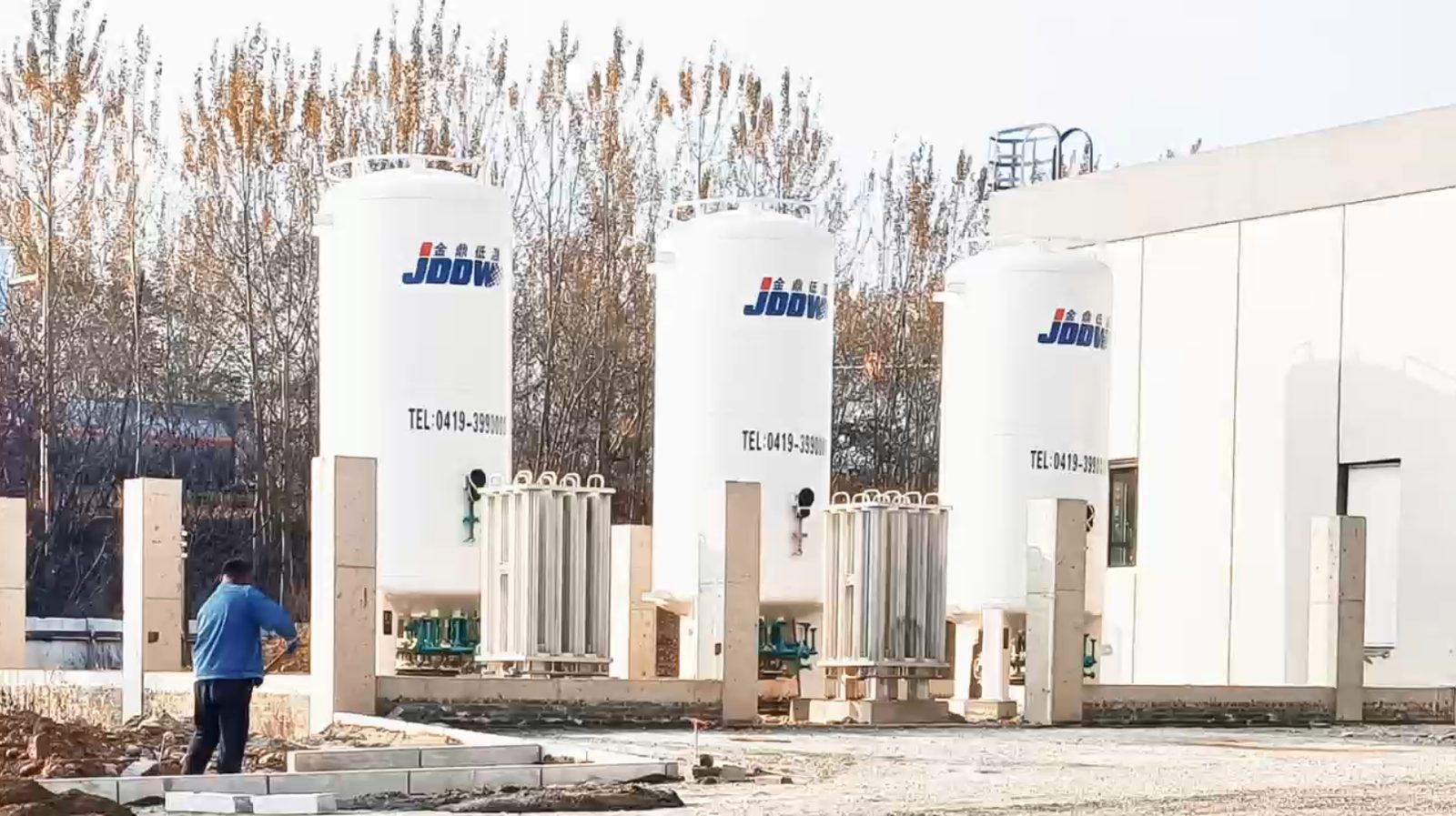
In industrial park centralized gas supply stations and similar scenarios, the installation of cryogenic liquid tanks (such as oxygen, nitrogen, and argon tanks) directly determines the safety and efficiency of the gas supply system. A complete installation diagram not only shows equipment layout but also clearly defines installation specifications and operational details, forming the foundation for ensuring long-term stable system operation.
The installation location of cryogenic liquid tanks must strictly comply with safety regulations. Regulations require tanks to be located away from open flames and heat sources, with perimeter fencing installed, and no flammable or explosive materials or low-lying areas within 5 meters. When selecting a location, special attention must be paid to the risk of carbon dioxide storage tanks accumulating in enclosed spaces, which may cause asphyxiation, and the risk of liquid nitrogen cracking due to low temperature, potentially established to explosions. It is essential to comprehensively consider ventilation conditions and the surrounding environment to completely eliminate potential safety hazards.
The installation precision of cryogenic liquid tanks directly impacts equipment operational stability. For vertical containers, installation must meet standards such as GB 50967-2014: verticality deviation shall not exceed 1/1000 of the equipment height (and shall not exceed 25.0mm), elevation deviation shall be controlled within ±5.0mm, and longitudinal and transverse centerline deviations shall be 5.0mm or 10.0mm based on the equipment outer diameter. Control of foundation settlement is equally critical, with overall inclination not exceeding 2/1000 of the tank diameter, and non-uniform settlement from edge to center not exceeding 1/300 of the radius. Taking a 700m³ liquid oxygen/900m³ liquid nitrogen tank as an example, the deviation of the foundation center coordinate must be controlled within ±20mm, elevation deviation within ±6mm, and tank wall plumbness not exceeding 4/1000 and not exceeding 50mm. Multiple measurements using tools such as theodolites and total stations are required before and after installation, as well as during operation, to verify these precision requirements.
The safety accessories of cryogenic liquid tanks are the core of ensuring operational safety. According to standards such as "Storage of Liquefied Petroleum Gas," tanks must be equipped with safety valves, pressure gauges, level gauges, and temperature gauges, and support remote transmission recording and alarm functions. Particular attention must be paid to the installation of emergency shut-off devices to prevent gas leaks similar to the carbon dioxide asphyxiation accident at the Erdos Xilan Microalga Company, which was caused by pipeline isolation failure. The configuration of safety accessories must comply with GB/T 18442 series standards to ensure effective risk control under extreme conditions.
Prefer outdoor areas with good ventilation and away from heat sources for the installation of cryogenic liquid tanks; installation precision must be strictly controlled using professional tools, with foundation settlement and tank verticality being key control points; the configuration of safety accessories must cover multi-dimensional monitoring such as pressure, temperature, and liquid level, and support remote early warning. Adhering to these specifications can effectively enhance the application reliability of cryogenic liquid tanks.
Cryogenic Pressure Piping and Components