
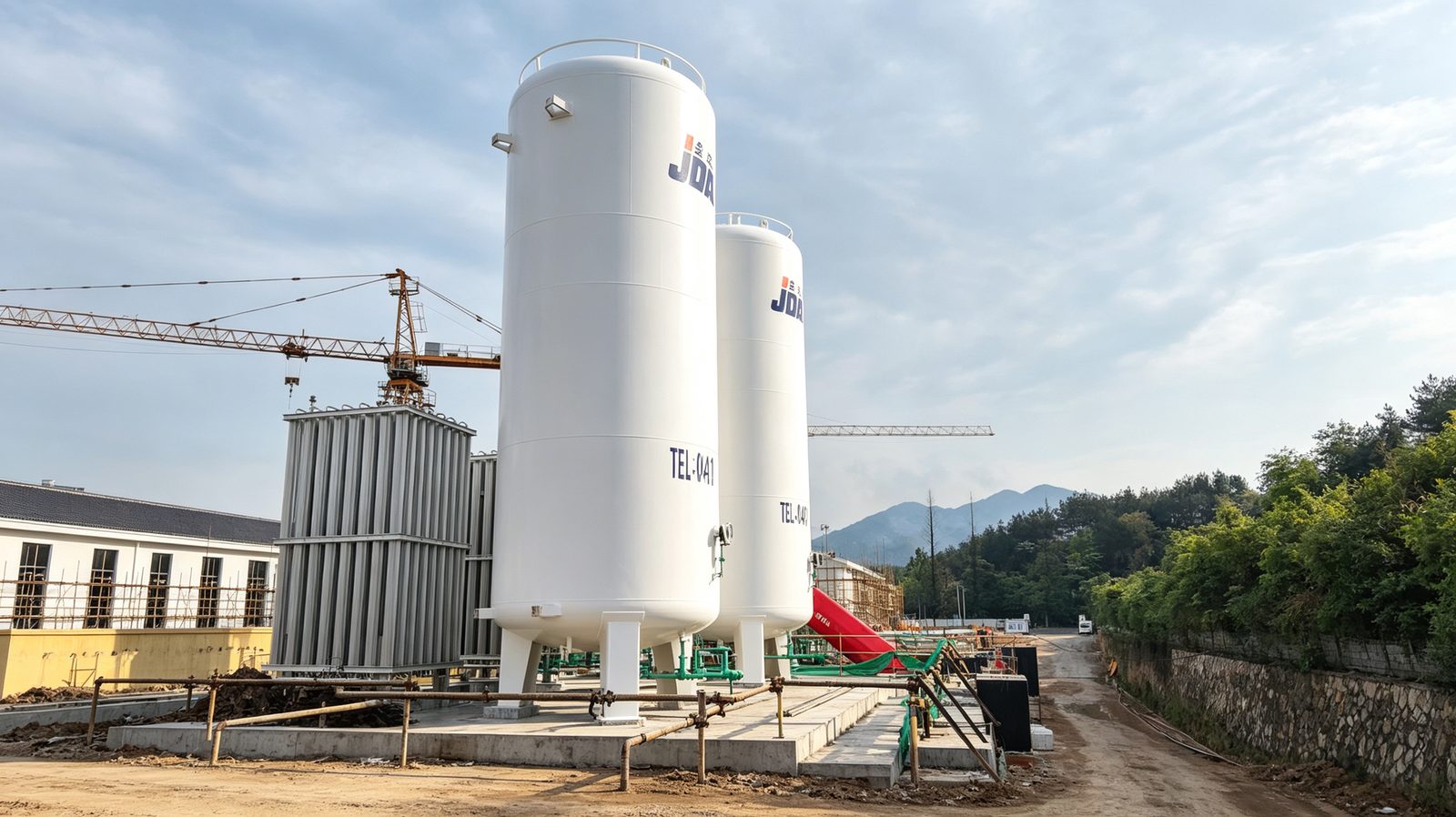
The geometric volume of liquid argon storage tanks directly impacts their potential risks, thereby determining the basic grade of safe distance requirements. The presence of flammable or explosive equipment nearby, or crowded personnel areas, requires further adjustments to the optimal final safe distance value. Relevant standards and specifications quantify safe distances, providing a basis for equipment selection and layout.
The geometric volume of liquid argon storage tanks is positively correlated with their potential risks. Taking devices with volumes ranging from 1m³ to 200m³ as an example, larger volumes store more liquid argon, and in the event of a leak or abnormal conditions, the potential hazard range is wider, thus requiring larger safe distance requirements. In semiconductor chip etching applications, high-purity liquid argon storage tanks (with purification devices) need to be paired with high-flow vaporizers and precision pressure regulating valve sets. This storage tank adopts a double-layer vacuum powder insulation structure, with the inner vessel made of S30408 stainless steel and the outer casing made of Q345R pressure vessel steel. Its design temperature can reach -196°C, ensuring structural stability under low-temperature conditions.
The characteristics of the storage tank's surrounding environment are the core factors affecting the optimal final value of safe distances. If flammable or explosive equipment (e.g., hydrogen stations, acetylene generators) or crowded personnel areas (e.g., production workshops, personnel passageways) are present near the storage tank, the safe distance needs to be further expanded on the standard basis. The GB/T 4842 series standards specify the purity grade of liquid argon, but do not directly limit specific numerical values for safe distances. Instead, they must be combined with the general requirements, terminology, and basic provisions of the GB/T 18442 series standards for fixed vacuum insulated cryogenic pressure vessels. This series of standards covers a complete set of specifications from material selection (e.g., GB/T 18442.2-2019's requirements for S30408 stainless steel used in the inner vessel and outer container) to design principles (GB/T 18442.3-2019's determination of design pressure and wall thickness).
The GB/T 18442 series standards provide calculation methods and minimum value requirements for safe distances of liquid argon storage tanks of different volumes. Safe distances need to be determined comprehensively based on factors such as the height of the storage tank body, working pressure (0.8MPa or 1.6MPa), design temperature (-196°C), and insulation method (vacuum powder insulation). Although ambient air vaporizers do not directly involve safe distance calculations, their matching with storage tanks (e.g., 50-2000 Nm³/h vaporization volume) affects the layout of the entire gas supply system, thereby indirectly impacting the planning of safe distances. The new GB/T 4842-2026 standard for pure, high-purity, and ultra-pure argon has been implemented since February 1, 2027. The manufacturing of storage tanks must comply with the process requirements of GB/T 18442.4-2019 "Fixed vacuum insulated cryogenic pressure vessels - Part 4: Manufacturing" regarding welding, shaping, and assembly to ensure structural strength and sealing meet long-term storage needs.
In specific application scenarios, when selecting liquid argon storage tanks, first clarify their geometric volume and determine the basic safe distance based on the GB/T 18442 series standards. Next, conduct on-site surveys to assess flammable or explosive risk levels and personnel density, increasing distances if necessary. Finally, verify the requirements of the GB/T 4842 series standards for liquid argon purity to ensure the storage tank's purification devices can operate stably over the long term. During pipeline maintenance, liquid argon storage tanks (e.g., 1m³ grade) temporarily stored need special attention to their distance from maintenance areas to avoid cross-operation risks. When filling a storage tank for the first time, fill it slowly and continuously monitor temperature changes to prevent structural abnormalities due to thermal shock. When selecting equipment, you can refer to the technical parameters of the Liquid Argon Storage Tank and prioritize devices with low evaporation loss and compliance with GB/T 18442 standards.