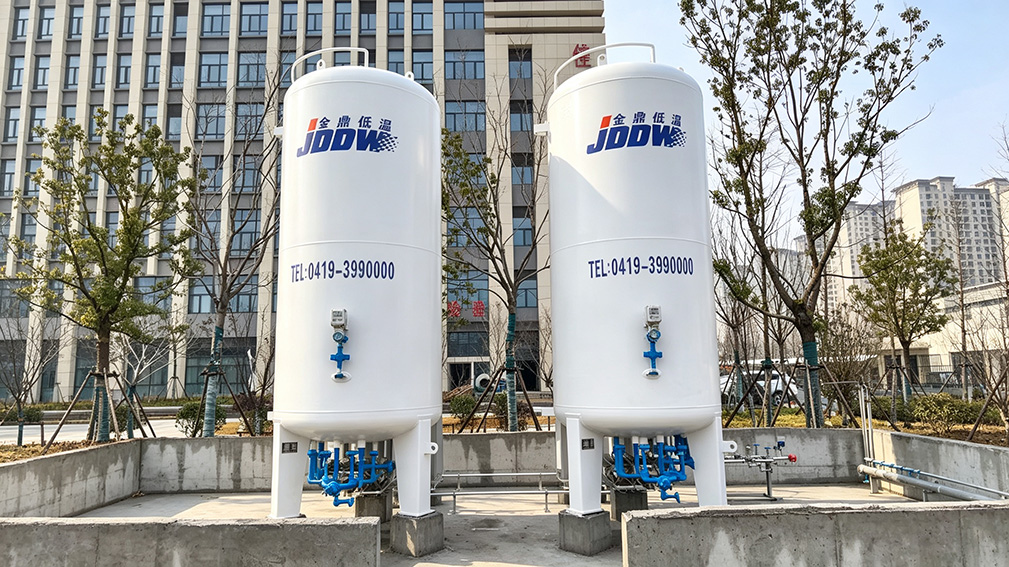
Medical liquid oxygen storage tanks are critical facilities for ensuring stable oxygen supply in hospitals around the clock. The fire separation distance between these tanks and hospital roads is designed with utmost importance. This distance is primarily determined by the geometric volume of the storage tanks. The larger the volume, the more oxygen is stored, and the longer the required safety distance. Additionally, hospital roads, as highly populated areas, have their daily traffic frequency and population density that directly influence the optimal final distance. The cryogenic properties (design temperature -196°C) and flammability of liquid oxygen impose extra requirements for low-temperature protection and fire prevention measures.
The geometric volume of medical liquid oxygen storage tanks directly determines the total amount of oxygen stored, thereby influencing the basic safety distance. For example, Liquid Oxygen Storage Tank specifications cover 1m³ to 200m³. Different volume specifications are designed with full consideration of the stored medium's characteristics. Hospital central oxygen supply systems commonly use 5-15m³ or 10-30m³ tanks, which are equipped with vaporizers, gas pressure regulating stations, etc., to ensure stable and reliable oxygen supply. The larger the volume, the greater the potential oxygen release, thus requiring longer fire separation distances to reduce risks.
Hospital roads, as densely populated areas, have their traffic frequency and population density as key factors in determining fire separation distances. Hospital interiors have high personnel mobility, especially in critical areas like operating rooms and ICUs. Therefore, when determining the distance between storage tanks and hospital roads, the population density must be comprehensively considered to ensure safe evacuation in emergencies. Moreover, hospital roads are often accompanied by other medical equipment, such as vacuum negative pressure suction stations, which also influence the optimal final distance.
The cryogenic properties and flammability of liquid oxygen require additional considerations for low-temperature protection and fire prevention measures in road separation distances. Liquid oxygen storage tanks continuously evaporate during storage, with a daily evaporation rate ≤0.15% (taking a 100m³ model as an example). This characteristic must be addressed in safety design. Additionally, the cryogenic temperature of liquid oxygen may cause material embrittlement upon contact, requiring sufficient distance to prevent low-temperature damage. Furthermore, the flammability of liquid oxygen necessitates firebreaks and corresponding fire protection facilities around storage tanks, further increasing the required safety distance.
When on-site measuring the fire separation distance between medical liquid oxygen storage tanks and hospital roads, steel tapes should be used for measurement and records. The specific distance must comply with relevant regulations and be optimized based on the hospital's actual layout. Verifying the integrity of steel tape measuring tools is the first step to ensure accurate measurements.