
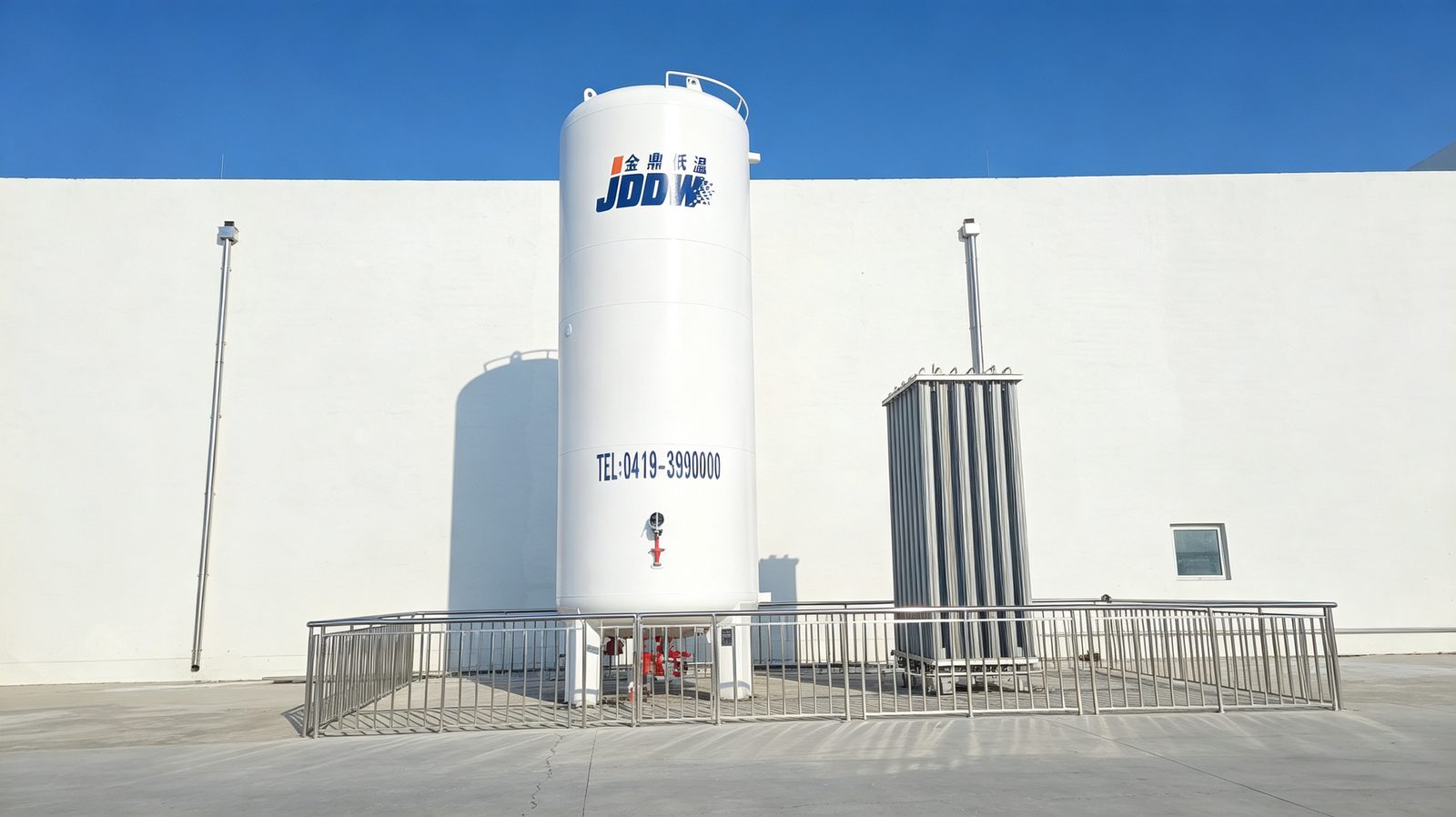
Biobanks and food rapid freezing require a -196℃ liquid nitrogen environment. The temperature and evaporation control of liquid nitrogen storage tanks directly impact storage effectiveness and operational costs, necessitating equipment selection matched to specific conditions.
The core requirement for biobanks is a consistently stable -196℃ environment. Self-pressurizing liquid nitrogen storage tanks ranging from 5-10m³ employ double-layer vacuum powder insulation. This structure maintains an extremely low evaporation rate, ensuring long-term operation can sustain design temperatures. The inner vessel uses S30408 stainless steel, while the outer shell is Q345R pressure vessel steel. After achieving the required vacuum level, heat intrusion from the external environment is significantly reduced, enabling stable long-term cryogenic storage.
For rapid liquid nitrogen evaporation, ambient air vaporizers are an ideal choice. These devices use ambient air as the heat source, exchanging heat with -196℃ liquid nitrogen through a novel aluminum alloy star-shaped fin array. The working pressure range covers 0.8~3.5MPa, with variable vaporization capacity from 50 to 2000Nm³/h, and no external energy is required, resulting in extremely low operating costs. In food rapid freezing, 10-20m³ liquid nitrogen storage tanks paired with this vaporizer can complete product freezing in 3-5 minutes, effectively preventing cellular damage.
Check whether the evaporation rate of storage tanks decreases with increasing volume. For example, tanks ranging from 1m³ to 200m³ exhibit a lower evaporation rate as volume increases, while ultra-large capacity tanks (above 200m³) require pressure reduction distribution skid systems for optimized evaporation control.
In practical applications, consider the operating conditions. Biobanks should prioritize tanks with an evaporation rate ≤0.25%, complemented by automatic replenishment systems and low liquid level alarm devices to ensure continuous supply. In food rapid freezing, the equipment selection must match the gas supply requirements of tunnel freezing machine liquid nitrogen spraying systems. For product details, refer to Liquid Nitrogen Storage Tank, or explore Principles of Vacuum Insulation Technology for Liquid Nitrogen Storage Tanks: From Interlayer Structure to Operational Key Points for technical specifics.