
CryoEase vaporizer selection is critical for stable cryogenic system performance, directly impacting gasification efficiency and equipment lifespan. For liquid nitrogen, key technical parameters must be evaluated.
Equipment must adapt to varying ambient temperatures, pressures, and flow rates. For example, at -196°C, cryoEase vaporizers with optimized jacket structures maintain ≤5°C shell surface temperature, reducing heat loss by 5% compared to standard designs.
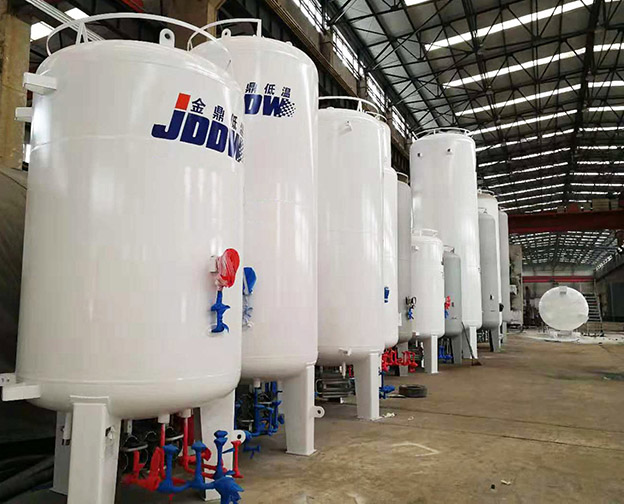
Interface compatibility with upstream liquid nitrogen tanks (e.g., those used in electronic component testing) is essential. Vaporizers should include bypass piping or flow regulators to handle pressure surges.
For 500L/h liquid nitrogen demand, shell-and-tube cryoEase vaporizers require heat transfer area calculated via Q=K·A·ΔT, where K accounts for 304 stainless steel and 0.8-1.2m/s flow rate. Precision applications (e.g., metal cryogenic assembly) require ≤2°C temperature differential with multi-stage mixing cryoEase technology.
Uniform gas phase distribution is achieved through recirculation pumps, ensuring consistent output for sensitive processes.
316L stainless steel with molybdenum offers 50% elongation at -196°C, while pressure components must comply with GB/T 150.1. EPDM seals last 15+ years in liquid nitrogen but require oxygen-free environments.
Liaoyang Jinding Cryogenic provides customized material recommendations and 3-year maintenance plans. Refer to safety protocols for cryogenic tanks for operational guidance.
Complete selection involves: 1) operational simulation; 2) material compatibility; 3) safety device configuration. Aerospace applications require additional fatigue testing. Liaoyang Jinding Cryogenic offers 1:1 prototype testing and custom non-standard vessels based on client drawings.
Focus on: 1) condensate discharge design; 2) tank interface standards; 3) explosion-proof certifications. Equipment tracking and periodic inspection standards extend operational life.