
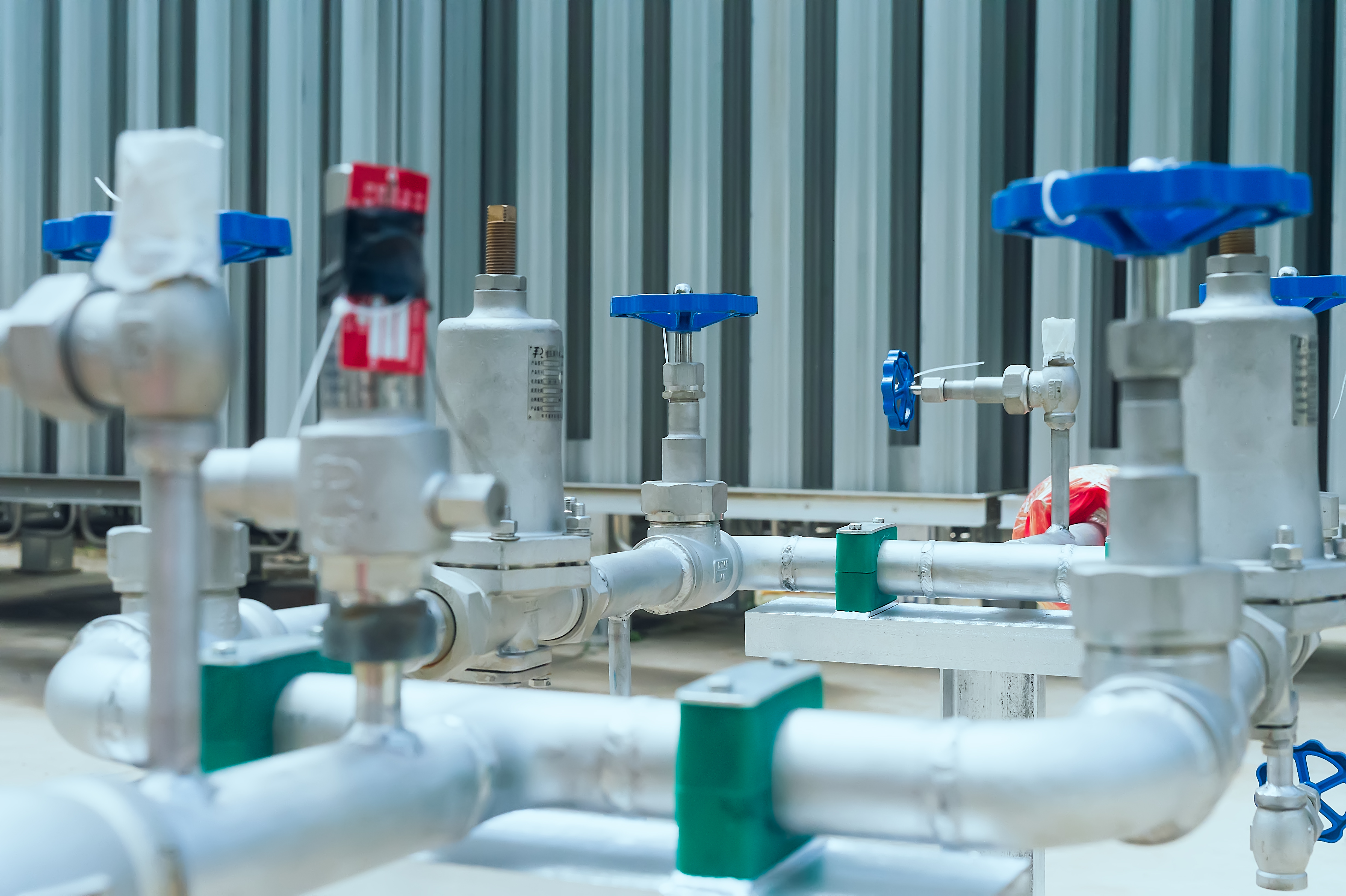
Liaoyang Jinding Cryogenic Equipment Co., Ltd. focuses on the R&D and manufacturing of cryogenic liquid storage and transportation equipment. Its main products include Cryogenic Storage Tanks, Vaporizers, Pressure Regulators, etc., and are widely used in Metallurgy, Chemical Industry, Medical, Food Industry, and other industries.
In gas supply systems for cryogenic media such as liquid oxygen, liquid nitrogen, and LNG, the Cryogenic Storage Tank is responsible for storage, and the Vaporizer is responsible for converting the liquid medium into gas. To deliver the vaporized gas downstream at a stable and accurate pressure, a Pressure Regulator is often indispensable. In actual operation, the Vaporizer outlet pressure is affected by factors such as liquid level, ambient temperature, and gas consumption fluctuations. If gas is supplied directly, pressure shocks or process parameter drift may easily occur. Therefore, properly configuring a Pressure Regulator is an important part of the stable operation of a cryogenic gas supply system.
The pressure source of a cryogenic gas supply system comes from the pressure-building vaporization of the Cryogenic Storage Tank and the vaporization process of the main Vaporizer. After liquid oxygen and liquid nitrogen are acted upon by the pressure-building coil inside the Cryogenic Storage Tank or an external pressure builder, they enter the Vaporizer; the outlet gas pressure is not a constant value. When gas consumption suddenly increases, the Vaporizer outlet pressure may drop; when gas consumption drops sharply or tank pressure build-up is too high, the outlet pressure may rise. Through the valve core and pressure-regulating mechanism, the Pressure Regulator automatically adjusts its opening, reducing and stabilizing the fluctuating inlet pressure within the set range, providing a continuous and stable gas source downstream.
At the same time, the Pressure Regulator can also protect downstream flow meters, solenoid valves, terminal equipment, etc. from transient high-pressure shocks. For LNG gas supply scenarios, the Pressure Regulator adjusts the vaporized natural gas to the pressure required by burners or engines, avoiding the impact of excessive pressure on combustion stability or triggering safety shutdown. In a complete cryogenic gas supply circuit, the Pressure Regulator serves as the “stabilizing node” for pressure distribution.
Selection should first confirm medium compatibility. Liquid oxygen systems are relatively sensitive to oil and grease; all parts in contact with oxygen should meet oxygen compatibility requirements. Although liquid nitrogen is an inert medium, the temperature is relatively low during the initial stage of low-temperature vaporization, so the valve body and sealing materials need to have good low-temperature toughness. LNG is a flammable gas, so the Pressure Regulator should consider explosion-proof, sealing, and corrosion resistance issues. The Gas Pressure Regulator provided by Liaoyang Jinding Cryogenic Equipment Co., Ltd. can be configured according to different medium operating conditions to meet the diversified needs of cryogenic gas supply systems.
Secondly, pressure and flow parameters must be checked. The inlet pressure should cover the upper working pressure limit of the Cryogenic Storage Tank and the possible transient pressure of the Vaporizer, while the outlet pressure should be set according to the requirements of the gas-using equipment. The flow rate should not be selected based only on average gas consumption; it should be combined with peak flow and leave an appropriate margin. If the nominal diameter of the Pressure Regulator is too large, regulation accuracy may deteriorate at low flow rates; if too small, it may cause insufficient gas supply or frequent movement of the valve core.
Pressure regulation accuracy and response speed are also critical. For processes with high pressure stability requirements, it is advisable to use pilot-operated pressure reducing valves or multi-stage pressure reduction to reduce the impact of Vaporizer pressure fluctuations on the terminal. The valve body material can be stainless steel, and seals can be made of low-temperature-resistant materials such as PTFE and PCTFE. When necessary, an inlet filter, built-in Safety Valve, or downstream pressure relief device should be configured. In addition, connection dimensions, nominal pressure, leakage class, and installation space should also be included in the selection scope. Low-temperature Pipelines experience cold shrinkage, and stress concentration should be avoided at the connection between the Pressure Regulator and the Pipeline.
Taking liquid nitrogen gas supply as an example, liquid nitrogen is drawn from the Cryogenic Storage Tank, vaporized by the Vaporizer into nitrogen at ambient temperature, and then passes through a Gas Pressure Regulator to adjust pressure before entering the gas consumption point. Similar solutions can be used in electronic component testing to provide a stable and clean protective gas source and avoid pressure fluctuations affecting the test environment; in metal cryogenic assembly, they are used to control the supply pressure of cryogenic media or protective gases, reducing local overpressure and the risk of liquid nitrogen splashing.
For sites with high requirements for continuous gas supply, it is recommended to set first-stage pressure reduction at the Vaporizer outlet and second-stage pressure reduction before the gas consumption point, and to configure a bypass or parallel branch to facilitate switching during maintenance. LNG systems should also incorporate venting, emergency shutdown, and leak detection measures in accordance with relevant gas codes. Liquid oxygen, liquid nitrogen, and LNG differ greatly in physical properties, so the sealing form, pressure regulation range, and safety accessories of the Pressure Regulator cannot be simply used interchangeably. Selection should be matched overall with the system design pressure, temperature, and flow. During commissioning, the inlet valve should be opened slowly first, and gas-using equipment should be gradually loaded after downstream pressure stabilizes, to avoid valve core impact or a sudden drop in Vaporizer outlet pressure caused by rapid opening.
In summary, the Pressure Regulator in a cryogenic gas supply system not only performs the pressure regulation function but also affects gas supply safety, process stability, and equipment service life. Only by selecting it in combination with the actual operating parameters of the Cryogenic Storage Tank and Vaporizer as well as terminal gas demand can media such as liquid oxygen, liquid nitrogen, and LNG be safely and stably delivered to every process link.